Request a demo
Please fill out this form to request a demo.
Loading form
Blog
Resurety
Continue reading for a summary of the discussion, to catch the webinar replay, and to access our co-authored white paper: 'From Volume to Impact: The Rise of Emissions-Adjusted RECs.’

Resurety’s “From price discovery to procurement: The rise of emissions-adjusted RECs” webinar participants: Devon Lukas, Senior Consultant (top left) and Robert Keene, Senior Director of Consulting (top right). Alongside S&P Global Energy’s Vittoria Morini, Americas Renewables Manager (bottom left) and Alice Mason, Global Head of Renewables Pricing (bottom right).
For years, renewable energy certificates (RECs) have served as the universal metric for clean energy: one megawatt-hour generated equals one REC. This simple framework was useful in driving early clean energy investment globally. But carbon accounting is evolving. As renewable penetration grows across power grids, it is becoming clear that clean power impacts vary significantly depending on when and where that energy is produced.
In our recent webinar, Resurety’s Devon Lukas (Senior Consultant) and Robert Keene (Senior Director of Consulting) alongside S&P Global Energy’s Vittoria Morini (Americas Renewables Manager) and Alice Mason (Global Head of Renewables Pricing) broke down how Emissions-Adjusted RECs (EA-RECs) combine granular grid emissions data with traditional market frameworks to help corporations make smarter, impact-driven procurement decisions.

In modern-day, the grid is getting cleaner, and that means not all megawatt-hours of clean power are created equal anymore.
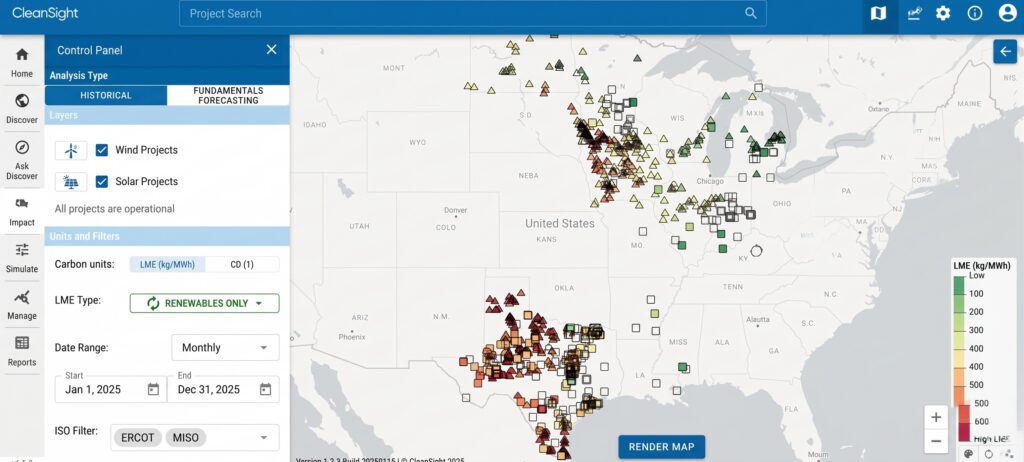
Traditional RECs certify clean energy generation, but they treat every megawatt-hour (MWh) the same whether it replaces dirty coal or feeds into a grid already overflowing with clean power. EA-RECs solve this gap by integrating locational marginal emissions (LMEs) to reflect real-world carbon reduction.
Rather than relying on static regional averages, LMEs serve as the engine behind EA-RECs by measuring carbon displacement at the exact hour and location generation occurs. As Devon Lukas explained, "LMEs calculate exactly which marginal plant gets turned down or dispatched down in real-time, accounting for grid congestion and local transmission constraints.”
S&P Global's Vittoria Morini summarized that "The level is set by the REC market, while the spread is set by the emission data."
Resurety’s Robert Keene walked through real-world scenarios showing how procurement teams can use EA-RECs to optimize their portfolios without altering standard underlying contract structures.
Keene highlighted that EA-RECs tell you the impact of clean energy on grid carbon emissions by providing an extra layer of granularity and visibility compared to standard RECs.
Large technology companies, data centers, and sustainability-forward corporates are leading the charge on EA-REC adoption. This is being driven by three main factors:
The energy transition is moving from a volume-based mindset to an impact-based mindset. Relying purely on traditional RECs leaves carbon impact on the table, and corporate buyers now have the data to do something about it.
Ready to take your clean energy procurement strategy to the next level? Access the newly released white paper ‘From Volume to Impact: The Rise of Emissions-Adjusted RECs’ for an in-depth look at the framework behind EA-RECs here.
Explore carbon accounting: Check out our two-part series on consequential accounting to learn how measuring impact drives real grid decarbonization.
And don't forget to check out the full webinar replay.
Cleansight
Complete the form to gain access to CleanSight Reports.

 Loading form