Request a demo
Please fill out this form to request a demo.
Loading form
Blog

Wenqing Zhang, Senior Managing Consultant
This blog presents highlights from our in-depth analysis on CleanSight Reports. For the full write-up, contact us today: [email protected].
Battery storage is booming, but not every market rewards it equally.
As battery storage grows across the U.S., the ability to charge when power is cheap (and sell when it’s expensive) is becoming central to battery economics. Arbitrage opportunities vary dramatically by market: across 22 trading hubs, the top hub earned more than three times the arbitrage value of the lowest.
Using TB4, a standard benchmark of the daily value a four-hour battery could capture, we compared 22 trading hubs across five ISOs over the past two years. PJM hubs lead the ranking, with Dominion Hub averaging $12.12/kW-month. SPP and MISO’s northern hubs form a strong middle tier, while ERCOT and CAISO, the markets with the largest battery fleets, rank lowest.
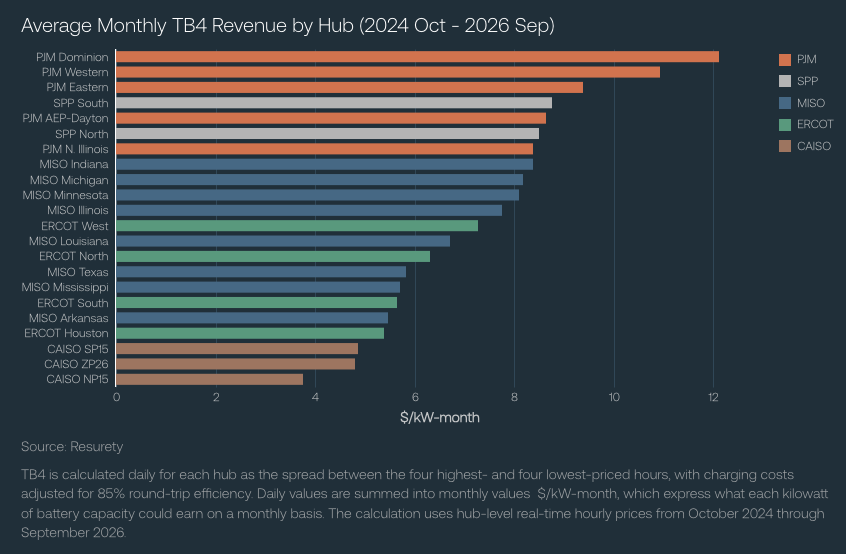
The differences come down to daily price patterns, battery buildout, and demand. PJM has the highest average evening prices while SPP benefits from strong overnight wind that pushes charging prices to some of the lowest levels in the country. In ERCOT and CAISO, large battery fleets have already flattened daily price swings. Meanwhile, data center growth in Virginia is pushing load in PJM’s Dominion zone steadily higher, a trend PJM expects to continue.
Arbitrage is only one part of battery revenue. Compared with what a new four-hour battery needs to earn to break even, about $16.10/kW-month, or $12.50 with the full 30% investment tax credit, a gap remains at most hubs, which batteries close through capacity payments, ancillary services, and contracts. But as those markets fill with batteries, arbitrage is likely to become an increasingly important share of battery economics.
Today’s rankings reflect where storage has and hasn’t been built, not a permanent leaderboard. Storage-scarce markets like PJM offer the strongest opportunities now, but that landscape will shift as new batteries come online. Developers, buyers, traders, and investors can use our platform to track how spreads, buildout, and demand evolve to see where value moves next.
Want to go deeper? These insights are drawn from our report Where Is the Arbitrage Opportunity Going for U.S. Batteries? on CleanSight Reports. The full report provides additional analytics and goes deeper into the drivers behind each market’s ranking and the breakeven economics of battery storage. Or, you can use Ask Discover to explore operating storage projects, historical and forecast TBx revenue, and nodal forecasts for site-level analysis.
To access the complete analysis, reach out to [email protected].
Cleansight
Complete the form to access the full analysis to learn more.

 Loading form