Request a demo
Please fill out this form to request a demo.
Loading form
Blog

Marion Cundari, Portfolio Analytics Manager
We estimate that roughly half of all U.S. virtual power purchase agreements (VPPAs) - representing nearly 100 GW - will soon need hedging. That represents billions of dollars in notional value, and a new market is forming quickly with the help of a hedging tool we’ve coined the Settlement Swap Agreement (SSA).
Our portfolio services team works closely with corporate energy buyers every day, supporting 25 GW of contracted energy. In the past, buyers approached their portfolio passively and focused on explaining historical contract settlements and forecasting future settlement, while separately pursuing new contracting opportunities. Today, the need is shifting toward actively managing existing portfolios.
For more than a decade, corporate buyers have used VPPAs to secure renewable energy credits to meet their sustainability goals and to manage long-term exposure to energy costs. In a VPPA, the buyer pays a fixed strike price for each megawatt-hour the project generates and receives the floating wholesale market price in return. When market prices are above the strike, the buyer collects the difference. When they fall below it, the buyer pays the difference.
Market swings driven by weather conditions, natural gas prices, policy shifts, and grid congestion mean settlement payouts often fluctuate dramatically from month to month and year to year, turning sustainability contracts into unpredictable financial assets and liabilities. Consequently, finance and treasury teams are demanding greater budget stability.
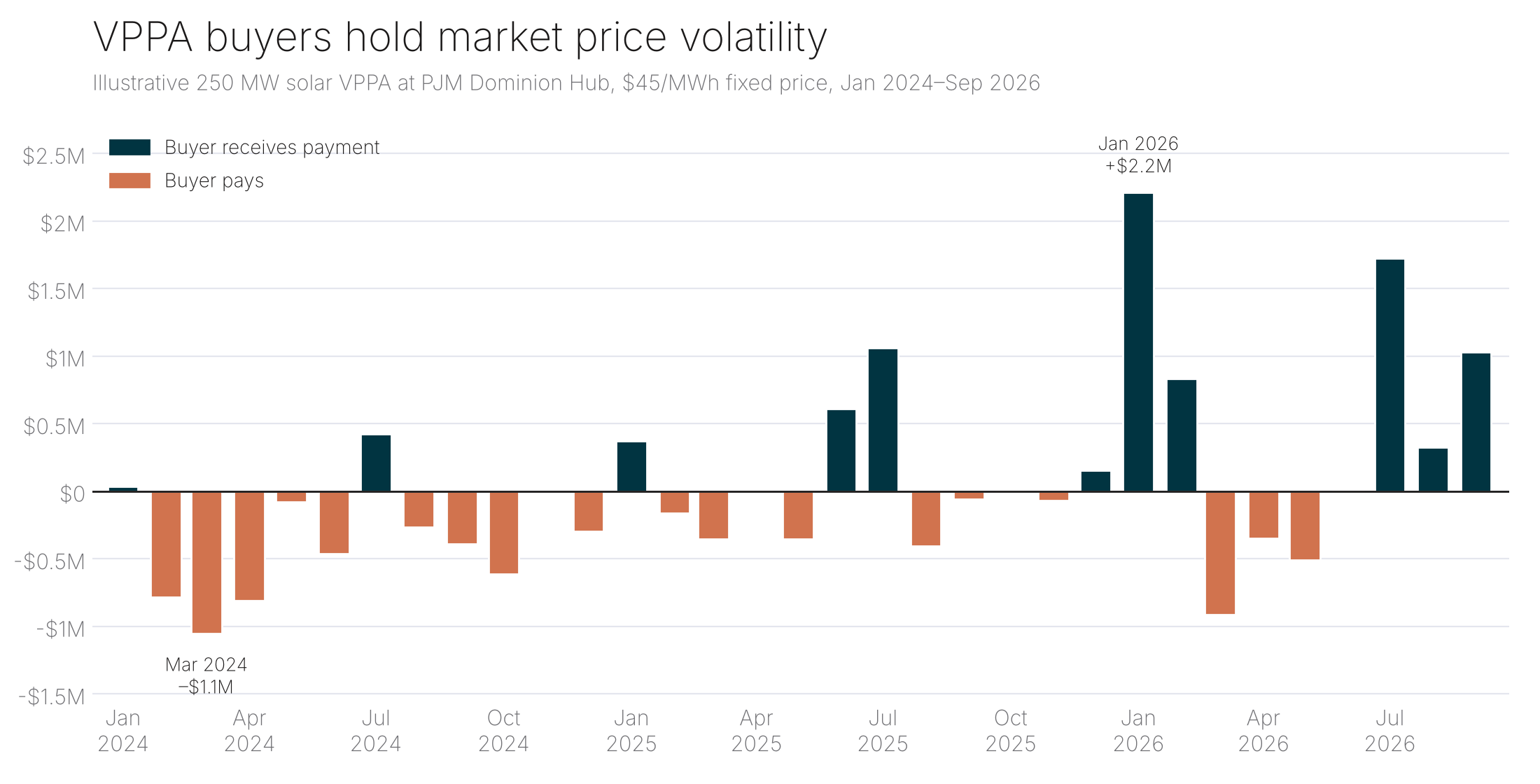
Before a buyer can decide whether to hedge, it needs a clear picture of what they are exposed to. We help corporate buyers understand and manage their clean energy contracts after they’re signed. We forecast future settlements across a full range of outcomes leveraging our Weather-Smart forecasting. We track project performance and audit VPPA settlements against modeled expectations, surfacing issues early to buyers that would have otherwise gone unnoticed. With that visibility, buyers can make an informed decision on whether to hedge their risk.
This is where Settlement Swap Agreements come in.
At its heart, an SSA is a mirror of a VPPA, where the trader takes on the market swings, while the corporate keeps the RECs they wanted in the first place.
How it works: VPPA buyers sell traders the market value of power that they get from the project at an agreed upon fixed price. Traders pay the clean energy buyer the set SSA price, and then get - or pay the difference - from the market price.
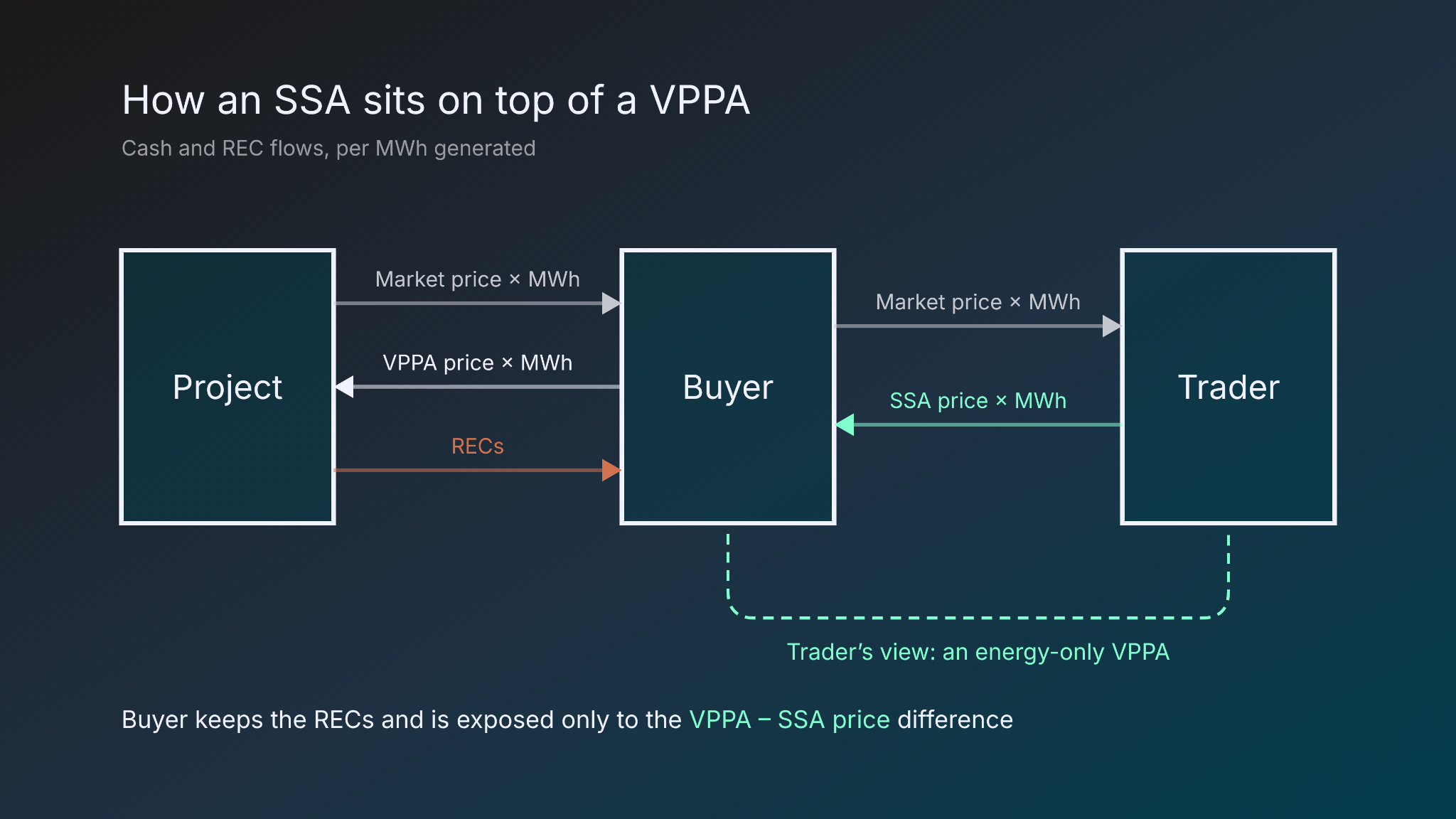
The structure is straightforward, and to help execute these deals efficiently, prepare your legal and finance teams with a few key parameters:
But, you can’t trade what you can’t see. Through our work with our portfolio clients, and via CleanTrade, the first and only CFTC-registered marketplace for clean energy, we are uniquely positioned to connect VPPA holders with counterparties to hedge their risk.
On CleanTrade, more than half of the $50+ billion in notional contract value comes from corporate buyers hedging power risk. The marketplace provides transparency into the market value or liability of a VPPA, and gives the ability to connect with counterparties who would transact at that price. As a regulated exchange, CleanTrade is a transaction enabler and an information service, delivering this growing market with the transparency, visibility, and compliance needed to make these deals happen.
This market is about to grow – fast. Join CleanTrade today for access.
We discussed this topic in detail during our webinar on October 22nd, Trading AsGen: The Next Liquid Frontier in Power Markets featuring our experts Marion Cundari, Owen Glubiak, and Aaron Perry. The replay is now available, please complete the form below to access.
Settlement swap agreements
Trading AsGen: The Next Liquid Frontier in Power Markets recording is now available. Complete the form to watch.

 Loading form