Request a demo
Please fill out this form to request a demo.
Loading form
Blog

Finn Doherty, Associate Consultant
This blog presents highlights from our in-depth analysis on CleanSight Reports. For the full write-up, contact us today: [email protected].
Electricity prices in the Northeast just got a lift.
The Q3 Auction for the Regional Greenhouse Gas Initiative (RGGI), the Northeast’s carbon cap-and-trade program for power generators, settled at an all-time high of $37.65/short ton CO2, representing an increase of almost 70% from the Q3 2025 auction.
With Virginia rejoining RGGI on July 1st for the first time since 2023, PJM's Dominion Hub is primed to see substantial increases to its already elevated power prices. A carbon price of $37.65 equates to an increase in costs of over $15-$22/MWh for a natural gas plant.
This will increase solar, wind, and storage value and electricity prices as a whole in Dominion Hub and the Northeast, assuming the market continues to operate as is. As Virginia becomes a primary data center hub in the US, increased load will only amplify the impact of this carbon price.
Established in 2009, the Regional Greenhouse Gas Initiative, or RGGI, is a mandatory greenhouse gas cap-and-trade program governing CO2 emissions by power plants in most states in the Northeast. The program includes Connecticut, Delaware, Maine, Massachusetts, New Hampshire, New Jersey, New York, Rhode Island, Vermont, and, most recently, Virginia. This initiative is intended to incentivize clean power generation in those eleven states.
In those states, RGGI carbon emissions allowances become part of the buildup of the marginal cost of operating for natural gas, coal, and oil power generation. When bidding into the day-ahead and real-time markets, plants think about their emissions costs in the same way they think about the cost of fuel. The high carbon costs make fossil units less economical, incentivizing clean energy to take its place.
Once a quarter, RGGI holds an auction for new CO2 allowances. Generators and investors place bids for the number of allowances they want and the price they’d be willing to pay. The auction operators then select bids, starting from the highest bid, and grant allowances until there are no more allowances for that auction. The auction then clears at the bid price of the last allowance, and all bids that were granted pay that price. Investors and generators can then trade the allowances they purchased on the secondary market as they desire.
In recent years, as demand for power has increased and the number of allowances has begun to decrease, auction prices have skyrocketed. Auction 73 on September 9th 2026 settled at $37.65/short ton. This continues the trend from the Q2 auction, which settled at $35. Just 3 years ago, in September of 2023, the auction cleared at $13.85. That is a 169% increase in a three year period. This has a real impact on the marginal cost of fossil fuel power generation and how frequently different gas and coal plants are deployed.
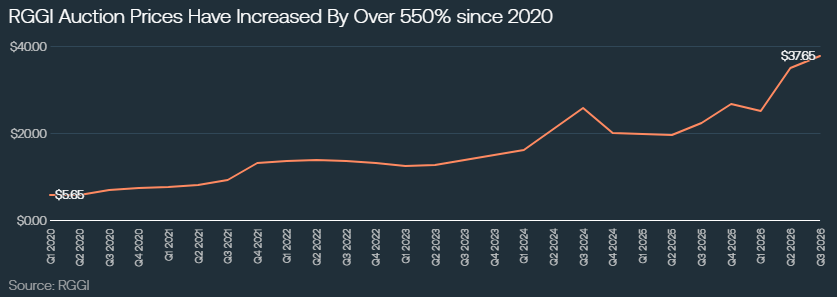
Trend analysis of Regional Greenhouse Gas Initiative (RGGI) auction prices from 2020 to 2026, highlighting a steady upward trajectory to a high of $37.65.
This most recent auction was slightly different. Virginia, which left RGGI in 2023, rejoined the program on July 1st, 2026, making the Q3 auction the first with Virginia allowances and bids in over two years. While this does mean there were additional allowances, it also means significant new demand for allowances from Virginia power plants.
Even with the new allowances, the market is getting more constricted. According to CAMPD emissions reports from the EPA, Virginia’s power emissions would have made up 37.7% of the emissions needing allowances in the RGGI states in 2025. However, Virginia’s additional allowances for the second half of the year only represent a 31.3% increase compared to the first half. This is a clear tightening of an already constrained market, which can be expected to continue the trend of recent high auction prices.
As a state with increasingly high load and fossil-intensive generators, Virginia's re-entry to RGGI will have a substantial impact on both power prices and RGGI carbon prices.
Buyers and sellers should expect elevated electricity prices throughout the Northeast, and most drastically in Dominion Hub. This will give wind, solar, and storage projects a sizable boost in their average pricing.
These insights are drawn from our report The carbon catalyst: How Virginia’s return to the carbon market is repricing power and renewables on CleanSight Reports. To better understand how RGGI pricing has shifted and what it means for your projects, reach out to access the complete text and analysis: [email protected].
Want to run custom scenarios on your own? Use Ask Discover, our new agentic analyst feature, to pull dynamic data and run analyses instantly. To discuss hedging your contracts against this new market volatility.
Cleansight
Complete the form to connect with the Resurety team and get access to our clean intelligence.

 Loading form