



Tag: fundamentals-based forecasting

Blog Post: Q2 2025 Weather-Smart Fundamental Forecasts Now Available

Author: Jennifer Newman, VP, Research, REsurety

Jen is photographed at NREL’s National Wind Technology Center in Boulder, CO. 

I am excited to share that our Q2 2025 Weather-Smart Fundamentals Forecast release is now available in REsurety’s CleanSight platform. Since 2022, our Weather-Smart Fundamentals Forecasts have helped customers better understand the connection between weather, market fundamentals, and project value. 

With our tools and services, customers can evaluate clean energy projects under expected conditions, stress test downside risk, and identify potential upside. They can build and track portfolios that help mitigate correlated risks — and measure the carbon impact of clean generation, storage, and consumption based on location, timing, and grid dynamics.

In this quarterly installment, we see prices remain relatively flat in the near term, but begin rising in the mid to long term as large new loads put added strain on the system.

Before jumping into the details of our latest forecast, it’s worth revisiting the fundamentals that make such insights possible.

What is a fundamentals model, and why are we using it?

My team’s goal is to forecast how power prices could evolve over the next 20 years, and we’re doing that with a fundamentals model. This means taking all the components that impact price formation — supply, amount of wind or solar generation, gas plant capacity, system demand, the constraints around how electrons move around — and solving for how to meet the region’s load at the least cost possible. It’s the same logic that underlies real-world power markets. The fundamentals model simulates those dynamics to predict future power prices.

Weather-Smart comes in because we don’t just do this simulation for typical weather conditions — we look at 40 years of weather variability and input that into our model to get a distribution of potential weather outcomes. That’s really important because weather can have a big impact on power prices. 

For starters, if it’s really hot in the summer, or really cold in the winter, demand is going to be higher, which tends to drive up the price of electricity. Weather also impacts the supply side, especially when renewables are involved. If it’s really cloudy or if it’s not very windy, then you’re not going to have as much wind or solar generation, and that will impact prices as well. Our Weather-Smart fundamentals modeling brings together all that weather variability along with market fundamentals to predict prices in the future.

From there the name of the game with forecasting prices is forecasting load growth. Most of the markets that we forecast — primarily ERCOT, MISO, and PJM — are expecting a lot of data centers to come online in the next 10 to 20 years, which will dramatically increase load. Many of these markets have not seen a ton of load growth year over year, so this is going to be an almost exponential increase in the amount of load on the system. They’re also expecting to bring more capacity online, including a significant amount of new renewables, along with gas and storage. 

Testing the limits of load growth

An important challenge is to determine if load forecasts are realistic. Do we think that all these data centers will actually come online? And if so, how can we build up the capacity to serve the load while avoiding rolling blackouts? 

In nearly all cases we erred on the side of making downward adjustments to ISO-provided load forecasts, to reflect a) more realistic rates of load growth and b) capacity build-out based on historical trends. We’re seeing many markets moving toward more solar now that it’s relatively cheap. This will cause the value of solar to decrease in a so-called cannibalization effect, where the more and more solar you get on the grid, the less valuable it becomes. Meanwhile as all that solar competes against other solar projects, bringing down energy prices, wind can get a positive edge.

Wind tends to be stronger at night, and as solar generation ramps up during the day, it pushes high prices into the evening. Wind can take advantage of that shift — capturing those higher prices and becoming more valuable as a result. Consequently, we’re starting to see wind value recover in markets that have historically low wind capture rates, such as ERCOT and SPP.
In some markets, we even see brief morning price spikes before solar kicks in, especially when wind has already tapered off — and storage is often well positioned to benefit from those early high-price hours too. 

More broadly, we closely track movements across these markets with the goal to produce the most realistic forecasts possible. We’re focused on what we think is realistic, while also showing the variability around that. This includes weather-driven variability, as well as scenarios based on different gas price assumptions. We provide both high and low gas scenarios to show how prices might respond, since gas plays such a major role in shaping the price of power.

Ultimately our goal is to reflect the most likely outcomes, while also accounting for the uncertainty built into both the weather and the fundamentals.

Want to learn more? Find more information in our Weather-Smart Fundamentals Modeling brief

Ready to dive into the Q2 2025 numbers? Customers, log in to CleanSight

DISCLAIMER: This blog post contains information related to REsurety and the commodity interest derivatives services and other services that REsurety provides. Any statements of fact in this presentation are derived from sources believed to be reliable, but are not guaranteed as to accuracy, nor do they purport to be complete. No responsibility is assumed with respect to any such statement, nor with respect to any expression of opinion which may be contained herein. The risk of loss in trading commodity interest derivatives contracts can be substantial. Each investor must carefully consider whether this type of investment is appropriate for them or their company. Please be aware that past performance is not necessarily indicative of future results.

All information, publications, and reports, including this specific material, used and distributed by REsurety shall be construed as a solicitation. REsurety does not distribute research reports, employ research analysts, or maintain a research department as defined in CFTC Regulation 1.71.

REsurety’s Weather-Smart Fundamentals Power Price Forecasts are Now Available

Solar Wind Energy
Adam Reeve, author of REsurety's Weather-Smart Fundamentals Power Price Forecasts are Now Available
Adam Reeve
SVP of Software Solutions

Here at REsurety, we know how important accurate forecasting is. We know that our customers need credible, explainable predictions of the expected value and upside/downside risks of the value of clean energy in order to make long-term investment or procurement decisions. And for that reason, for the better part of the last ten years, our team has been developing and improving upon long-term power price and renewable generation forecasting models. Up until now, however, those forecasts have relied on machine-learning methods and have only been available on a limited basis to customers via our Advisory services. We’re excited to announce that as of today, we have released a new fundamentals forecasting model, and are making it available across all of our product and service offerings including our SaaS platform, REmap.

REsurety developed our latest fundamentals forecasts in order to give our customers unprecedented ease of access and confidence about the future value of their clean energy projects. With these newly released forecasts, you can:

  • Develop an optimal portfolio: simulate portfolio performance under a range of outcomes to develop/manage your portfolio.
  • Calculate project-specific forecasts: all of our forecasts are natively calculated using project-specific hourly generation, so you can calculate the expected performance of your project with one click in REmap.
  • Stress test: gain visibility into downside risk driven by weather variability or changes in market dynamics, e.g. increased storage penetration, a hot summer/winter, or the impact of high renewables build out.

The Importance of Weather Variability

The most distinguishing characteristic of REsurety’s forecasts is that we don’t just model a single weather-normal year (e.g., an 8760), because we know that models based on 8760s will likely overestimate value for renewables, underestimate value for storage, and underestimate variability across all projects. Instead, we simulate ~40 years of representative hourly weather – and the impact that has on every project and load center on the grid – to develop a thorough distribution of possible weather outcomes. Importantly, this means that hourly project-specific generation is an input into our model, as opposed to being calculated after the fact.

This extremely data-intensive and compute-hungry approach is designed to give customers the answers that they need about the future. Users can: run sophisticated portfolio simulations across projects and markets using realistic and consistent weather inputs; confidently calculate the value of storage, where profitability is highest during periods of extreme weather and market volatility; and calculate the expected value and downside risk in their PPAs for accurate budgeting.

Unlike traditional forecast providers, REsurety’s fundamentals-based forecasts realistically take into account a range of possible weather conditions and the impact that they have on each project in order to solve for power prices in each hour. The plot below shows the value of the approach: for each of the five market scenarios, 40 representative weather-years (represented by thin lines) are simulated in the model. We’re calling this realistic approach to weather variability “Weather-Smart.”
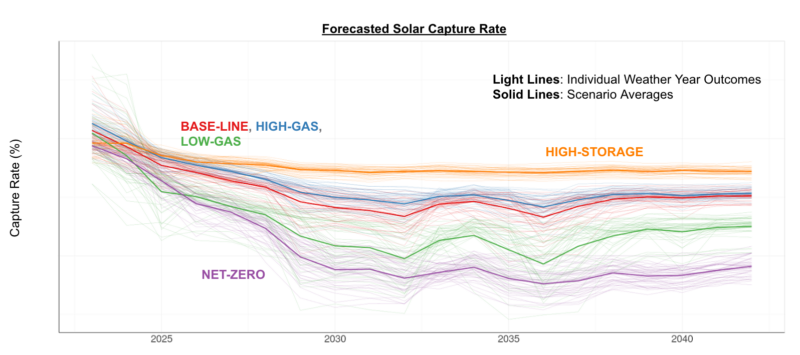
The value of full weather distributions: weather and various market scenarios drive variability in the capture rate for solar generators.

“We’re excited to bring together our strengths in Atmospheric Science and Power Market Analytics in this model release,” said Adam Reeve, SVP of Software Solutions at REsurety. “Traditionally, those two fields have been separate in the industry, limiting the ability for customers to apply forecasts to their clean energy projects or portfolios. This Weather-Smart approach gives users a much more robust way of forecasting the value of clean energy.”

Why A Fundamentals Model?

REsurety’s newest forecasts leverage an hourly production cost model that accurately represents the operational and market design complexities of the power markets. It takes into account the physical power flows, hourly generation from each renewable plant, hourly load, and future market conditions inputs to solve for hourly power prices. As an example, this means that, in each hour, we model the generation at every renewable plant on the grid (based on localized wind speeds / solar irradiance, turbine / panel type, etc.) as well as production costs for dispatchable generators. We also model load in each hour, as well as the transmission limitations of the grid and other market-specific characteristics. Given these inputs and constraints, we then solve for power prices in the same way that a system operator (such as ERCOT) would.

After years of creating advanced models, we’ve learned that such a rigorous approach has a number of advantages over machine-learning (ML) models. Specifically, ML models struggle to make accurate predictions about a future that may look very different from the recorded history – such as predicting price formation in a market with a rapidly changing installed base of grid-scale storage. Results from ML models are less interpretable, making it harder for customers to understand why a certain price was produced – and by extension whether it is reasonable or not. Lastly, ML approaches are less capable of accurately simulating how changes to market rules or regulatory policies will impact prices. For these reasons, REsurety has invested in the latest fundamentals-based model that we’re excited to release today.

REsurety’s Weather-Smart fundamentals power price forecasts are currently available in ERCOT, with CAISO available later this year and full market coverage by mid 2023.

To learn more, please visit http://resurety.com/remap or email [email protected].

Return to the blog post main menu.