Scope 2 rules are changing, and the ripple effects will hit every corner of the clean energy market. If the current trajectory continues, buyers will face higher costs to meet their goals. Developers may need to structure offtake contracts differently. Investors will likely be asking new questions about value and risk.
When accounting rules change in any market, the effects cascade through all market participants – starting with the companies doing the accounting, but rippling through everyone in the value chain. REsurety’s data and analytics bring clarity to clean energy contract value and risks under a range of accounting rules, so you are working from a clear foundation no matter how the market evolves.
Now let’s take a closer look at the potential changes coming to Scope 2 accounting — and what’s at stake for your business.
Understanding the upcoming Scope 2 revisions
Scope 2 emissions are associated with purchased electricity, which is often treated as essentially synonymous with grid-based electricity use. Under the current market-based accounting method, procured clean energy…
Scope 2 rules are changing, and the ripple effects will hit every corner of the clean energy market. If the current trajectory continues, buyers will face higher costs to meet their goals. Developers may need to structure offtake contracts differently. Investors will likely be asking new questions about value and risk.
When accounting rules change in any market, the effects cascade through all market participants – starting with the companies doing the accounting, but rippling through everyone in the value chain. REsurety’s data and analytics bring clarity to clean energy contract value and risks under a range of accounting rules, so you are working from a clear foundation no matter how the market evolves.
Now let’s take a closer look at the potential changes coming to Scope 2 accounting — and what’s at stake for your business.
Understanding the upcoming Scope 2 revisions
Scope 2 emissions are associated with purchased electricity, which is often treated as essentially synonymous with grid-based electricity use. Under the current market-based accounting method, procured clean energy — through unbundled RECs or bundled PPAs — is assigned against electricity consumption and counted as zero emissions, regardless of when and where the clean energy generation happened. So the net emissions reported only reflect emissions from the remaining balance of grid-based electricity use.
Now the Greenhouse Gas Protocol is revising Scope 2, with new standards expected to come into force in 2028. Though voluntary, the Protocol is the standard used for 97% of corporate disclosures, so the incentives created by the Protocol will shape corporate purchasing activity, which in turn will impact investors and project developers.
Two distinct Scope 2 proposals are on the table:
Hourly matching (24/7 carbon-free energy [CFE]). Matching consumption with clean generation in the same grid, in each hour of the day. The theory behind this approach is that same-hour, same-location matching will result in more accurate claims about plausibly consumed electricity. In other words: it’s easier to be accountable when the project is on the same grid, and if the energy was generated at the same time as it was consumed. This approach encourages the purchases of clean energy close to load, and – because of the constant balancing required to match consumption and generation – is expected to drive more activity in the spot market rather than long-term purchase agreements (such as PPAs).
Consequential emissions accounting. Some refer to this as “impact accounting” as well. Rather than attempting to match megawatt-hours of electricity usage or consumption, this approach measures the emissions impact of electricity usage/generation – such as induced emissions from load, or emissions avoided by clean generation – and adds up those impacts. The resulting incentive for a corporate buyer is to focus on clean energy procurement in the dirtiest grids, not necessarily the areas closest to their load. This approach offers lower cost implementation thanks to increased flexibility, more effective decarbonization, and also encourages the long-term purchases of power that drive global impact.
At the moment, it looks like hourly matching will be required as part of future reporting rules, and consequential emissions accounting will be a parallel reported metric. Here, we’ll focus on hourly matching, given it looks more likely to be a required part of future reporting standards.
Turning Scope 2 challenges into opportunities
As Scope 2 rules evolve, companies will need to navigate rising costs, new technologies, and shifting market dynamics. But these challenges also create opportunities for careful planning and smart strategies to make a real difference.
Challenge #1: Rising costs
Most studies agree that hourly matching will result in higher costs. If hourly matching becomes a requirement, increased costs will come from i) the need to buy zero or low-carbon power in times and locations when it is scarce, and ii) meaningfully higher transaction and management costs to matching of clean power and consumption. Auditing costs will also likely increase, as the volume and complexity of data required increases significantly.
So, think about your portfolio and business goals: How much clean energy will you need to buy over the next five or ten years? What is your current portfolio of purchases, and how does that leave you exposed in a changing accounting environment? In which hours and locations are you most likely to be long/short relative to your forecasted load, and what will the cost be to close those gaps partially or fully? How much will external risks – such as hourly weather variability or a changing power market supply stack – impact your carbon claims?
The time is now to start asking these questions. We are seeing a race for procurement of good projects as buyers scramble to lock in favorable contracts that will be “grandfathered in” before accounting rules change. In addition, even though the rules don’t take effect until 2028, large projects like a data center or a multi-year renewable deal take years to develop – making now the time to start planning.
Solution: REsurety can help you optimize spend
We know the rules, we know the policies, we know the markets – and we share your goals. We can talk dollars and cents to help you make the right decisions for your clean energy purchasing strategy.
For example, we helped one of the world’s biggest tech companies evaluate the cost of various strategies to meet their emission reduction goals through clean energy procurement: hourly matching, annual matching, and consequential carbon matching. We laid out the impact in multiple scenarios and the financial costs of each strategy.
The work helped leadership within the sustainability, finance and procurement functions of the organization to understand the cost / benefit analysis with each path, clarifying what each decision would mean for the overall business. In the end, we helped bring clarity to energy purchasing, enabling them to move forward a plan with a view on expected costs, ensured alignment with sustainability goals, and reduced financial risk.
Challenge #2: It’s going to require new solutions – from hardware to systems design
Some corporate clean energy buyers will need to consider new generation or reporting technology to meet new accounting requirements which may impact emissions goals. This might include diligence of new technologies (such as battery storage or carbon capture), optimizing renewable integration, or improving reporting systems.
If the GHGP Scope 2 rules go toward CFE/hourly time-matching, demand will rise for non-intermittent resources (i.e., dispatchable fuel types – like storage, nuclear, geothermal, and gas with carbon capture & sequestration [CCS]). For traditional thermal generation like natural gas power plants, if carbon capture is added, there would be a dramatic reduction in emissions that would flow through to companies that buy power from those resources.
Solution: REsurety can help you understand and de-risk new technologies
REsurety helps evaluate and implement the right technologies for your portfolio.
For example, using technology to foster around-the-clock low-carbon power is a strong complement to renewables. Our consulting practice recently worked with an organization to evaluate CCS technology at a large cogeneration plant, considering the technology from a range of angles (emissions considerations, carbon accounting limitations / benefits, time-to-value, comparison to next best alternatives, etc.). As natural gas-fired generation expands its role as a critical flexible resource to enable load growth, understanding new solutions like CCS will become more important.
Challenge #3: The voluntary market will shift
Corporate buyers, who voluntarily procure clean energy to offset their emissions footprint, are critical to new clean energy projects getting built. Long-term offtake agreements in the form of virtual power purchase agreements (VPPAs) or REC purchase agreements provide increased revenue stability to the project, thereby enabling access to critical project finance. Our recent analysis for the Clean Energy Buyers Association (CEBA), shows just how important this clean energy purchasing has been in the past: corporate voluntary clean energy purchases were shown to reduce project financial risks by up to 90%.
There is growing concern that a scenario where buyers must purchase hourly clean energy within the grid region where they operate – as hourly 24/7 would require – would make it harder for big corporations to make long-term contractual agreements. Why invest in an expensive and complex long-term agreement if you can’t use all of the resulting power for sustainability claims (due to inevitable hourly mismatch between generation and your consumption)? The business case quickly erodes. As a result, many people expect that hourly matching accounting rules will drive the market away from long-term offtake agreements and towards a short-term, hourly spot market. This will require projects to secure alternative means of offtake to fill the gap left by corporates (and it’s a big gap: 41% of US offtake over the past decade was driven by corporate purchases). New approaches to active portfolio management contracting structures and risk allocation approaches will be required.
Solution: REsurety gives you the tools for active portfolio management
The era of “set it and forget it” long-term PPA management is over, and a shift to hourly matching will accelerate that transition. Buyers, sellers, and traders are now actively engaging in shorter-term portfolio management trades to manage the exposures associated with long-term PPAs. Our team helps buyers evaluate portfolio management strategies – ranging from brokered spot market purchases, to a blend of long-term and short-term purchases, to crafting strategic long-term commitments. After setting a strategy, buyers and sellers can execute transactions on CleanTrade, the only federally regulated marketplace for clean energy. It provides near real-time data on projects that are available for purchase or sale, and liquidity/transparency needed to act quickly in response to changing demand requirements and market conditions.
Turning change into opportunity
Scope 2 is entering a new chapter. The rules are still being written, but one thing is clear: data-driven strategy is more important than ever. Paying attention now will put you ahead down the line.
REsurety was built for moments like this. With the right data and strategy, you can align budgets, manage risk, and make credible carbon claims. Whether you’re deciding how to buy, where to site, or which claims to make, we help you act with confidence and ensure your portfolio meets your business goals.
At the end of the day, our vision is simple: more clean energy, period. Let’s get your portfolio ready now so when the rules land, you’re already where you need to be.
Any statements of fact are derived from sources believed to be reliable, but are not guaranteed as to accuracy, nor do they purport to be complete. No responsibility is assumed with respect to any such statement, nor with respect to any expression of opinion which may be contained herein. The risk of loss in trading commodity interest derivatives contracts can be substantial. Each investor must carefully consider whether this type of investment is appropriate for them or their company. Please be aware that past performance is not necessarily indicative of future results.
Thank you to the Clean Energy Buyers Association for organizing a great spring summit in Minneapolis last week! It was a fantastic opportunity to reconnect with energy leaders and learn more about the current state of the market.
Here are five key takeaways that emerged from discussions with industry experts and innovators:
1. Speed to Capacity is Key
In today’s climate, electricity generation (of any form) is a national security and economic issue, not just a “renewables” issue. Renewables, storage, and gas (if you’ve already ordered a turbine, that is) are the fastest way to add the capacity to the grid that is needed to accelerate the data center development fueling AI.
2. Shifting Procurement Focus
In light of high costs and scrutiny on corporate budgets, corporate purchasers are exploring new options in addition to “traditional” greenfield vPPA strategies, including procuring clean power from operational projects, shorter terms (under 10 years), purchasing long-term REC strips, and working more with utilities for low-carbon power supply.
3. GHG Accounting Debate
The role of 24/7 clean energy in the Greenhouse Gas Protocol is being heavily debated, with concerns about feasibility, costs, data availability, and emissions benefits highlighting the need for practical approaches for carbon accounting. There is universal recognition that the incentives shaped by the Greenhouse Gas Protocol should empower companies of all shapes, sizes, and locations to take ambitious and meaningful climate action via a range of technologies.
4. Commitments Are Staying Firm – For Now
Despite some industry headwinds, it was exciting to see corporate buyers remain committed to their climate goals. That said, we caution against celebrating too early: buyers are working under increased budget pressure, so we are seeing more companies looking at ways to manage costs and risks carefully.
5. The Voluntary Market Has Been Expanding
The clean energy buyer ecosystem has been visibly expanding. Two directions of expansion include 1) companies relatively early in their decarbonization journey seeking “high impact” options for reducing emissions, and 2) larger organizations using their buying power on behalf of suppliers to decarbonize their supply chain (and associated Scope 3 emissions).
What were your top takeaways from the CEBA Summit? Let us know in the comments here.
Here at REsurety, we know how important accurate forecasting is. We know that our customers need credible, explainable predictions of the expected value and upside/downside risks of the value of clean energy in order to make long-term investment or procurement decisions. And for that reason, for the better part of the last ten years, our team has been developing and improving upon long-term power price and renewable generation forecasting models. Up until now, however, those forecasts have relied on machine-learning methods and have only been available on a limited basis to customers via our Advisory services. We’re excited to announce that as of today, we have released a new fundamentals forecasting model, and are making it available across all of our product and service offerings including our SaaS platform, REmap.
REsurety developed our latest fundamentals forecasts in order to give our customers unprecedented ease of access and confidence about the future value of their clean energy projects. With these newly released forecasts, you can:
Develop an optimal portfolio: simulate portfolio performance under a range of outcomes to develop/manage your portfolio.
Calculate project-specific forecasts: all of our forecasts are natively calculated using project-specific hourly generation, so you can calculate the expected performance of your project with one click in REmap.
Stress test: gain visibility into downside risk driven by weather variability or changes in market dynamics, e.g. increased storage penetration, a hot summer/winter, or the impact of high renewables build out.
The Importance of Weather Variability
The most distinguishing characteristic of REsurety’s forecasts is that we don’t just model a single weather-normal year (e.g., an 8760), because we know that models based on 8760s will likely overestimate value for renewables, underestimate value for storage, and underestimate variability across all projects. Instead, we simulate ~40 years of representative hourly weather – and the impact that has on every project and load center on the grid – to develop a thorough distribution of possible weather outcomes. Importantly, this means that hourly project-specific generation is an input into our model, as opposed to being calculated after the fact.
This extremely data-intensive and compute-hungry approach is designed to give customers the answers that they need about the future. Users can: run sophisticated portfolio simulations across projects and markets using realistic and consistent weather inputs; confidently calculate the value of storage, where profitability is highest during periods of extreme weather and market volatility; and calculate the expected value and downside risk in their PPAs for accurate budgeting.
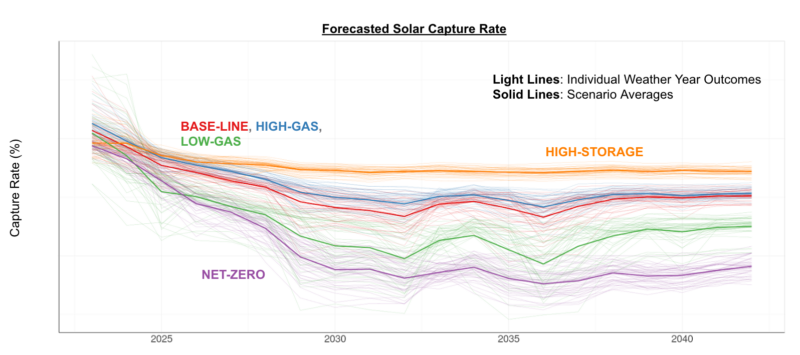
Unlike traditional forecast providers, REsurety’s fundamentals-based forecasts realistically take into account a range of possible weather conditions and the impact that they have on each project in order to solve for power prices in each hour. The plot below shows the value of the approach: for each of the five market scenarios, 40 representative weather-years (represented by thin lines) are simulated in the model. We’re calling this realistic approach to weather variability “Weather-Smart.”
The value of full weather distributions: weather and various market scenarios drive variability in the capture rate for solar generators.
“We’re excited to bring together our strengths in Atmospheric Science and Power Market Analytics in this model release,” said Adam Reeve, SVP of Software Solutions at REsurety. “Traditionally, those two fields have been separate in the industry, limiting the ability for customers to apply forecasts to their clean energy projects or portfolios. This Weather-Smart approach gives users a much more robust way of forecasting the value of clean energy.”
Why A Fundamentals Model?
REsurety’s newest forecasts leverage an hourly production cost model that accurately represents the operational and market design complexities of the power markets. It takes into account the physical power flows, hourly generation from each renewable plant, hourly load, and future market conditions inputs to solve for hourly power prices. As an example, this means that, in each hour, we model the generation at every renewable plant on the grid (based on localized wind speeds / solar irradiance, turbine / panel type, etc.) as well as production costs for dispatchable generators. We also model load in each hour, as well as the transmission limitations of the grid and other market-specific characteristics. Given these inputs and constraints, we then solve for power prices in the same way that a system operator (such as ERCOT) would.
After years of creating advanced models, we’ve learned that such a rigorous approach has a number of advantages over machine-learning (ML) models. Specifically, ML models struggle to make accurate predictions about a future that may look very different from the recorded history – such as predicting price formation in a market with a rapidly changing installed base of grid-scale storage. Results from ML models are less interpretable, making it harder for customers to understand why a certain price was produced – and by extension whether it is reasonable or not. Lastly, ML approaches are less capable of accurately simulating how changes to market rules or regulatory policies will impact prices. For these reasons, REsurety has invested in the latest fundamentals-based model that we’re excited to release today.
REsurety’s Weather-Smart fundamentals power price forecasts are currently available in ERCOT, with CAISO available later this year and full market coverage by mid 2023.
Listen in to this podcast where EnergyMatters2U hosts REsurety’s SVP of Software Adam Reeve as he details the company’s mission to empower the clean energy fueled future.
We use cookies on our site to analyze traffic and enhance your experience. For more information, visit our privacy policy. By clicking “accept" or continuing to browse this website without disabling cookies, you consent to the use of cookies.